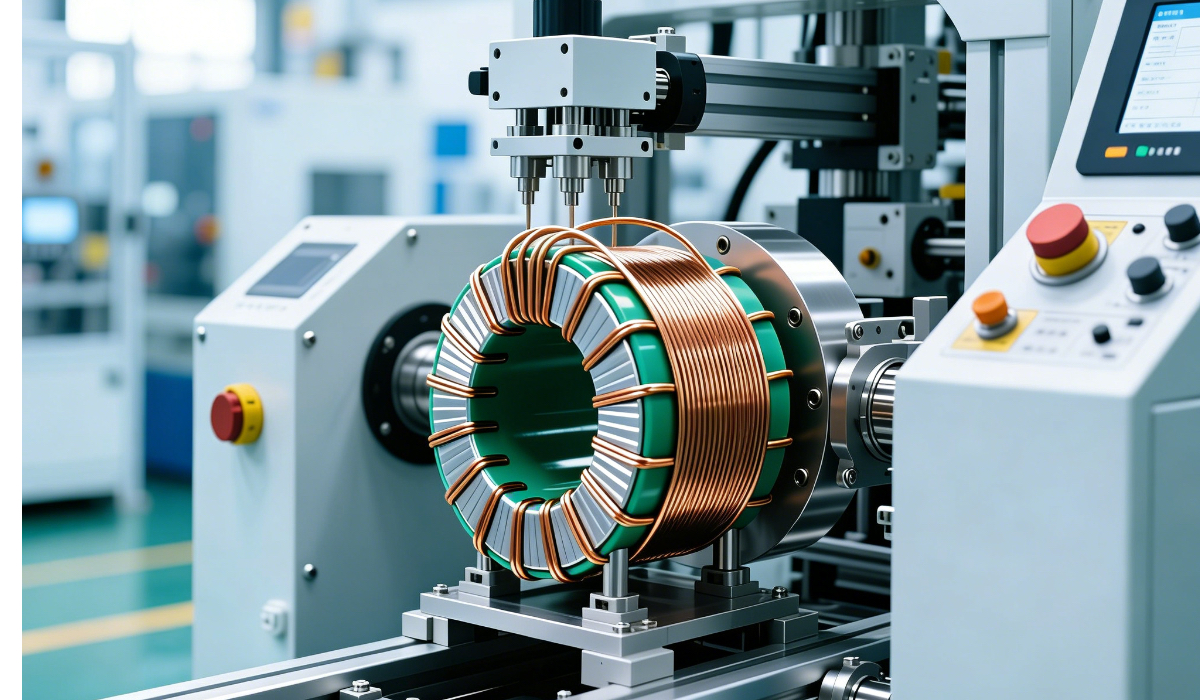
In today's rapid development of power electronics technology, whether it is parking chargers (OBCs), DCDC converters, or high-performance high-power server power supplies for new energy vehicles, they are pursuing higher power density and smaller size. Traditional round enameled wire windings usually have a space utilization rate (fill rate) of only $40\%-50\%$ due to the large gap between the coils, which has gradually become a bottleneck that limits the further improvement of inductor performance.
In this context, the flat wire winding process came into being. By tightly winding the wire of the rectangular section, the filling rate can be significantly increased to more than $80\%$. However, the leap from "round" to "flat" is not only a change in the shape of the wire, but also a severe challenge to the accuracy and process control of winding equipment.
1. The core advantages and market drive of flat wire technology
The reason why flat wire is favored by the industry is mainly due to its three major physical properties:
Very low skin-effect loss: In high-frequency environments, current tends to flow across the conductor surface. Flat wires have a larger surface area and can effectively reduce AC losses.
Excellent heat dissipation performance: The flat coil has close contact between layers, the heat conduction path is short, and the heat dissipation efficiency is much higher than that of round wire coils.
Size advantage: The volume of the flat wire inductor can be reduced by $30\%-50\%$ under the same power requirements, which is perfectly suitable for the compact installation space of automotive electronics.
Size advantage: The volume of the flat wire inductor can be reduced by $30\%-50\%$ under the same power requirements, which is perfectly suitable for the compact installation space of automotive electronics.
At present, the world's mainstream new energy vehicle companies have fully switched to flat wire inductor solutions, which has directly driven the explosive demand for high-precision flat wire winding machines.
2. Technical deep water area: the "three major difficulties" of flat wire winding
Despite the obvious advantages, there are extremely high technical thresholds for flat wire winding, especially vertical winding processes, in actual automated production:
1. Protection and tension control of enameled film
During the winding process of flat wire, the edge of the wire is subjected to great stress. If the tension control of the winding machine is not stable enough, or the guide mechanism is not properly designed, it is easy to rub and scratch the enameled film, resulting in a breakdown short circuit in the high-voltage test.
2. Rebound and precision compensation at bends
When the rectangular wire is wound into a round or square coil, it will produce a serious rebound phenomenon at the bending angle due to the elasticity of the material. How to compensate the servo motor in real time through the algorithm to ensure the consistent shape size after winding is the core index to measure the quality of a winding machine.
3. The wiring logic of the vertical winding process
Compared to flat winding, the edgewound process requires the wire to be wrapped in a "standing" position. This places almost strict requirements on the wiring mechanism, spindle torque and the fineness of the fixture.
3. Solution: Technological breakthrough of high-precision vertical winding machine
In response to the above process difficulties, the modern flat wire round/square vertical winding machine has achieved stable production through a number of optimization technologies:
Precision tension control system: Servo active wire feeding and high-precision tension sensor linkage are used to ensure that the wire maintains a constant tension during the whole winding process, effectively avoiding the micro-enamel film caused by pressure fluctuations
Damage, improve the insulation performance of the coil.
Multi-axis linkage servo control: Through the multi-axis linkage algorithm, the winding trajectory is accurately controlled, which can realize the continuous vertical winding of round, square and even irregular special-shaped coils, and control the rebound error at the micron level.
Modular fixture design: For flat wires of different specifications (different thickness and width ratios), the equipment supports quick mold change, significantly reducing the cost of changeover.
4. Conclusion: Automation is the consistent basis for stable quality
In the field of inductor manufacturing that pursues high reliability performance, traditional manual or semi-automatic winding methods are difficult to fully meet the strict requirements of "high consistency" for modern automotive-grade products. The use of fully automatic and intelligent flat wire winding equipment is not only to greatly improve the production efficiency of the production line, but also to achieve accurate traceability and stable control of the quality of each inductor through digital process parameter management.
With the popularization of new energy high-voltage platforms, the flat wire process is evolving in the direction of higher precision and more compactness. Manufacturing enterprises that can continue to optimize the core process of winding will surely win technological opportunities in this wave of industrial upgrading.