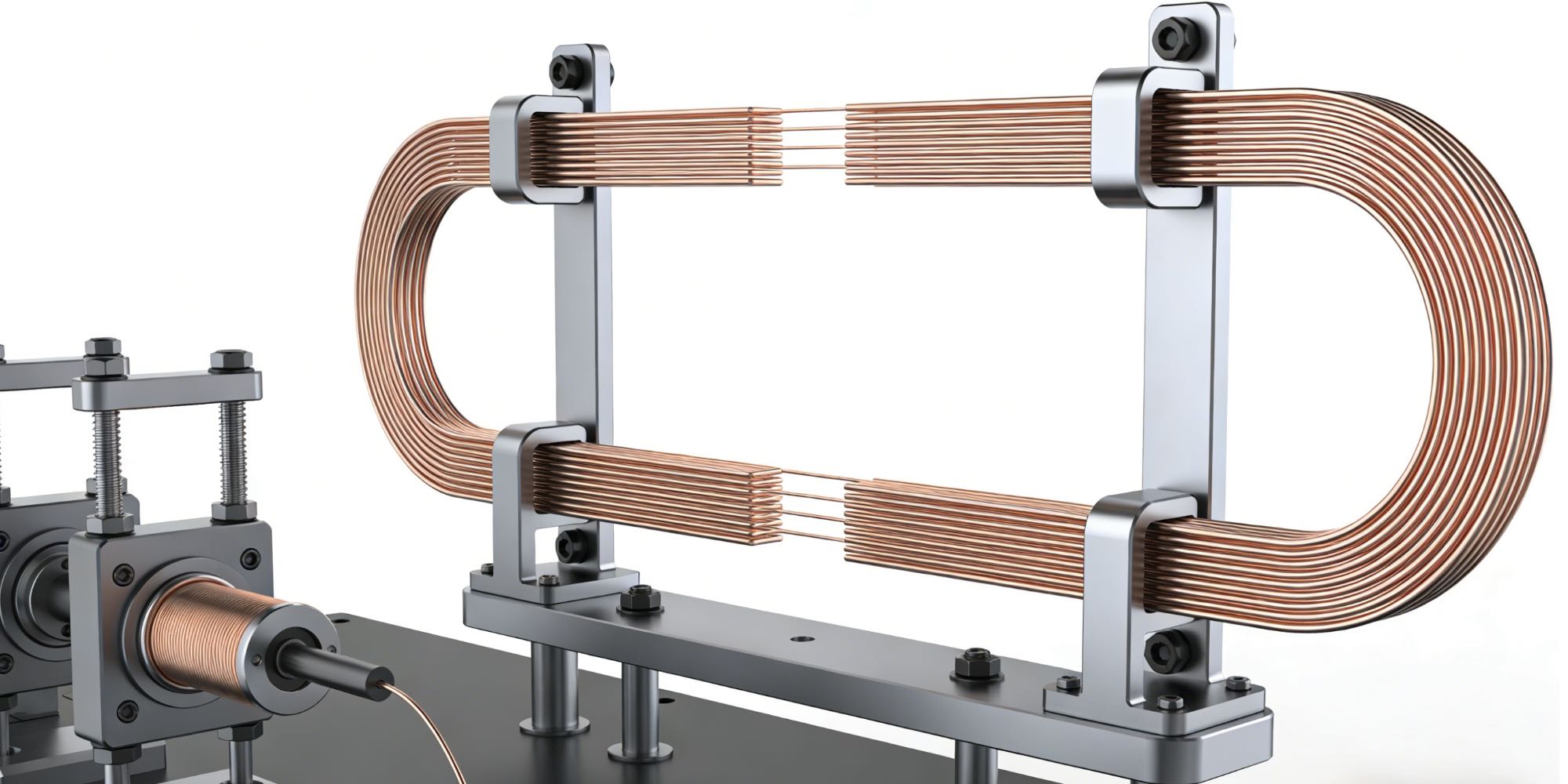
In the manufacturing of high-performance inductors and transformers, the choice of winding process often directly determines the electromagnetic efficiency and stability of components. When traditional spiral winding is inadequate in the face of high-frequency interference (EMI) and high current density challenges, the "figure-8 winding" process is becoming the preferred solution for medium and high frequency and high-power electronic components with its unique physical structure. As a leader in precision winding technology, we are helping our customers overcome technical problems in complex coil forming through the deep automated integration of the "figure 8 winding" process.
1. What is figure 8 winding? What makes it different?
The so-called "figure-8 winding" (also known as cross-winding method or butterfly winding method) means that the wire does not simply circulate in one direction during the winding process, but through a precise control system, the wire forms a cross-overlapping path similar to the "figure-8" shape.
This seemingly complex geometric structure actually contains profound electromagnetic principles:
Magnetic Field Cancellation Effect: Through the figure-8 current path, the magnetic field generated by adjacent coils can achieve phase cancellation to a certain extent, thereby significantly reducing leakage induction and improving electromagnetic interference (EMI) resistance.
Good structural stability: When traditional spiral winding is stacked in multiple layers, it is easy to cause interlayer displacement due to wire slippage. The physical intersection of the figure 8 winding plays a self-locking role, making the overall structure of the coil extremely stable.
Excellent thermal management: The special voids formed by the figure-8 winding facilitate air convection, especially when used with flat wires, which greatly reduces the temperature rise caused by the high-frequency skin effect.
2. Process pain points: Why is it difficult to achieve "fully automatic" figure 8 winding?
Despite its excellent performance, the processing difficulty of figure-8 winding is much higher than that of ordinary winding. Traditional semi-automatic equipment often faces the following bottlenecks in production:
Trajectory control is extremely difficult: The cable needs to frequently change the bending angle and cable logic in high-speed motion, and any small synchronization error will lead to "jumpers" or damage to the cable.
Violent tension fluctuations: Due to the nonlinearity of the winding path, the tension of the wire will instantly surge at the intersection, and manual adjustment can hardly guarantee that the enameled film will not be stretched or chipped.
Long changeover cycle: For figure-of-eight coils of different diameters or proportions, traditional equipment often requires a large number of precision cams or expensive molds, and the flexible production capacity is extremely poor.
3. Core solution: technical breakthrough of 8-figure round/square continuous vertical winding machine
In response to the above challenges, the 8-figure continuous vertical winding series equipment we have developed has completely realized the mass production of this process through algorithm optimization and structural innovation:
Multi-axis servo synchronization algorithm: High-performance motion control chip is used to realize nano-level synchronous compensation between spindle and spool. Whether the coil is round or square, it maintains a precise figure-8 trajectory and dimensional consistency.
Dynamic Constant Tension System: Integrates active wire feed mechanism and closed-loop tension sensor. Even at the intersection of path mutations, tension fluctuations are controlled to a very low range, effectively protecting the flat wire enameled film and ensuring insulation performance.
Modular and flexible design: For flat lines with different width and thickness ratios, only need to simply adjust the parameters on the operation screen, and combine with the quick-change fixture to complete the change, greatly improving the utilization rate of the single machine.
4. Conclusion
The wide application of the figure 8 winding process marks the transformation of inductor manufacturing from "large-scale production" to "refined customization". Through the fully automatic and high-precision figure 8 winding machine, manufacturers can not only obtain better product electrical indicators, but also win competitive advantages with differentiated technical strength in an increasingly homogeneous market.